


AnimalProtech Blog
Why do flamingos stand on one leg?
Flamingos may tuck up one leg to reduce heat loss, while their anatomy makes the pose surprisingly stable. Studies support both benefits, but some questions remain open.
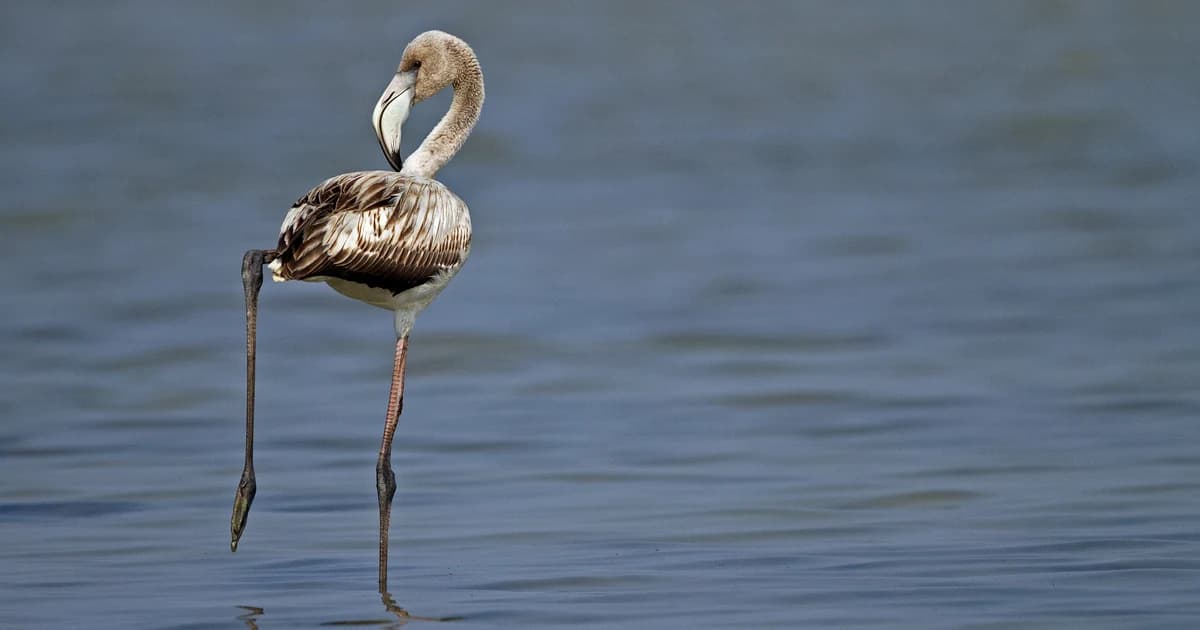
Watch a flamingo at rest and one leg often seems to vanish into its feathers. The other supports the bird for minutes at a time, even in shallow water. What looks awkward to us appears to be an ordinary resting position for the flamingo.
Two explanations have the strongest evidence so far: the pose may limit heat loss and may also be mechanically easy to hold. The studies complement each other, but neither provides a complete answer for every species or setting.
Cooler conditions make one-legged resting more common
In a 2010 study of captive Caribbean flamingos, the birds rested on one leg more often while standing in water than while on land. The behaviour also became more frequent as the air temperature fell. These findings support the idea that the posture helps conserve body heat.
Flamingos lose heat through their long, unfeathered legs. By tucking one against the body, a bird leaves less surface exposed to cool air or water. The study found no consistent preference for the left or right leg: individual birds used both.
The posture may require less effort than it appears
A 2017 biomechanics study tested two Caribbean flamingo cadavers and recorded eight juvenile Chilean flamingos on a force plate. The cadavers could passively support their weight on one leg when set in the right posture. In the live trials, quiet birds with their eyes closed swayed less than alert birds, and the force beneath the foot stayed close to the joint.
Together, the results suggest that flamingo anatomy can make one-legged standing both stable and mechanically economical. That is more precise than saying a flamingo simply “locks its knee”: the study describes a passive, gravity-driven support mechanism in the joints higher in the leg. It did not directly measure muscle activity in living birds, so it cannot show that they use no muscular effort.
There is still room for more research
The studies involved captive birds from only a few species, and the biomechanics work used just two cadavers and eight juveniles. Muscle activity was not measured directly in the living birds. More work with wild flamingos is needed to learn whether the same patterns hold outside captive groups.
Heat conservation and mechanical stability are not competing explanations. A posture that exposes less leg to cool air or water and is relatively easy to hold could offer both benefits at once. Studies of wild flocks and direct, non-invasive measurements of muscle activity could show how their importance changes with weather and behaviour.
Watch flamingos without changing their behaviour
At a wetland, notice when flamingos tuck up a leg, swap sides or place both feet back in the water. Stay on marked paths and viewing platforms, keep well back from resting or feeding flocks and use binoculars instead of approaching for a photograph. Never call, bait or flush birds to make them change position. The best observation is one that lets the flock carry on undisturbed.
Frequently asked questions
- Do flamingos always stand on the same leg?
- No. The captive Caribbean flamingos studied in 2010 showed no consistent preference for the left or right leg, and individual birds used both.
- Is standing on one leg tiring for a flamingo?
- Probably not as tiring as it looks. Cadaver tests revealed a passive support mechanism, while force-plate observations found very little sway in quiet birds. Because muscle activity was not measured directly in the living birds, the exact effort remains uncertain.
- Do flamingos stand on one leg only to stay warm?
- Heat conservation is supported by observations, especially in water and at lower temperatures, but it is unlikely to be the whole explanation. The posture's passive stability may provide an additional benefit.
References
- Anderson and Williams — Why do flamingos stand on one leg? - Peer-reviewed zoology study
- Chang and Ting — Mechanical evidence that flamingos can support their body on one leg with little active muscular force - Peer-reviewed biomechanics study
- PubMed Central — open-access text of the flamingo biomechanics study - Open-access research article