

AnimalProtech Blog
How to prevent bird-window collisions: what works
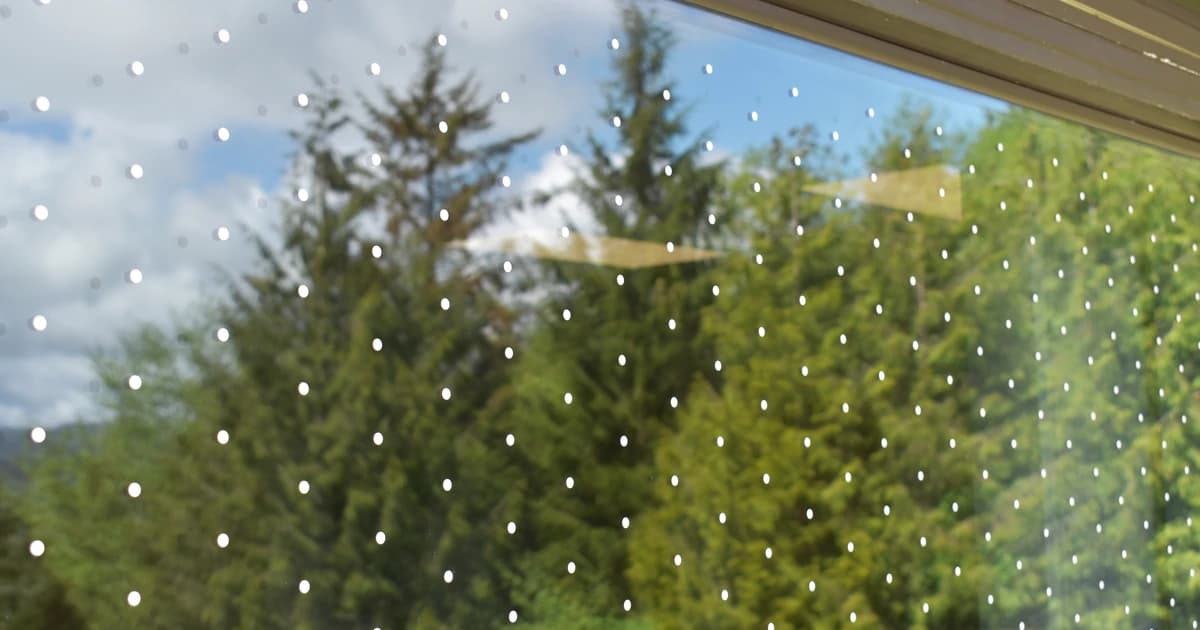
Closely spaced markers on the outside of glass can break up reflections before a bird reaches the pane. A real-world test helps explain why full coverage matters.
A window may reflect trees and open sky so clearly that a flying bird sees somewhere to go, not a solid barrier. Transparent corners and glass walkways create a similar illusion. The problem is not confined to towers or migration hotspots: homes, schools, shelters and other low-rise buildings can all have dangerous panes.
A single decorative sticker leaves most of the reflection intact. A more useful retrofit covers the exterior face of the glass with small, closely spaced markers. Recent field research adds evidence that this kind of full-surface treatment can reduce collisions.
What a real-world test found
A study published in Ornithological Applications compared six treated façades at two Oklahoma State University buildings with 134 untreated façades. The exterior white dots were 0.64 centimetres across and spaced 5.1 centimetres apart both horizontally and vertically. The study's adjusted estimates suggested that collision rates at treated façades fell by 67.2% to 71.6%, while rates at untreated façades rose by 15.7% over the comparison period.
Those figures are descriptive estimates, not a guarantee for every building. Only six façades received the treatment, and the formal before-and-after comparison with the controls did not reach statistical significance. Even so, the observed direction matched earlier field studies. Larger tests across different climates, building types and products are still needed.
A useful pattern must cover the glass
US Fish and Wildlife Service guidance recommends applying markers to the outside, where they interrupt reflections before a bird reaches the pane. For small birds, marks at least a quarter-inch—about six millimetres—across should form a grid with no more than two inches, or roughly five centimetres, between them. Medium or light-coloured markers tend to stand out against darker reflections.
Dense dots are not the only option. Exterior screens, properly installed netting, closely spaced hanging cords and exterior films can also make glass safer. A lone hawk silhouette leaves large apparent flight paths around it; silhouettes work only when repeated densely enough to function as a pattern.
This is also a Neotropical conservation issue
A 2025 open dataset assembled 4,103 collision reports from 11 Neotropical countries, spanning 1946 to 2020. The records came from systematic surveys, public agencies and incidental observations, so they cannot be used to calculate a regional death total. They do show that collisions affect a wide range of birds across Latin America and the Caribbean, rather than belonging to one country or season.
Start with the panes birds are likely to hit
- Look at the building from outside and note glass that reflects vegetation, sky or feeders.
- Check transparent corners, balcony rails and panes that appear to offer a route through the building.
- Treat the full exterior surface, following the spacing specified for the chosen system.
- Record strikes before and after treatment so recurrent hazards are not missed.
- At night, close blinds and switch off lighting that is not needed, especially during migration.
Prioritising a window with documented strikes is worthwhile, but prevention works best when every hazardous pane is assessed. A visible, continuous pattern changes what the bird sees before impact.
Frequently asked questions
- Will one bird-shaped sticker stop window collisions?
- Usually not. A single sticker leaves large areas of reflected or transparent glass untreated. Markers need to form a closely spaced pattern across the hazardous surface.
- Should window markers go inside or outside?
- Outside is generally more effective because the pattern interrupts the reflection on the exterior surface. Follow the product instructions and check that weathering has not created gaps.
References
- Ornithological Applications — real-world field test of white dot window markers - Research paper
- US Fish and Wildlife Service — preventing bird collisions with buildings and glass - Government guidance
- Ecology — Neotropical bird-window collision dataset - Research paper